In philosophy and science, a first principle is a basic proposition or assumption that cannot be deduced from any other proposition or assumption. It is a fundamental source or basis of something; a foundational quality or attribute determining the nature of something; a truth, law, or belief that serves as a foundation or guide for behavior, ideas, and decision-making; the foundation or theory from which specific actions, decisions, or other truths are derived.
Economics is the study of how entities make choices about how to use scarce resources to satisfy unlimited wants and needs.
Relying on first principles brings understanding and clarity to the environment, the available options, and the effects of our choices.
First Principles Economics is a boutique economic advisory firm, with education, expertise, and direct experience in the design, implementation, operation, trading, contracting, monitoring, and regulation of energy markets.
First Principles Economics is a sole proprietorship of Dr. Ron McNamara – services include economic analysis, expert witness testimony, market education/training, regulatory compliance, market and regulatory strategy.
Follow Einstein
If I had an hour to solve a problem I’d spend 55 minutes thinking about the problem and 5 minutes thinking about solutions…The formulation of a problem is often more essential than its solution, which may be merely a matter of mathematical or experimental skill.
To break a mental model is harder than splitting the atom…The world as we have created it is a process of our thinking. It cannot be changed without changing our thinking.
One cannot alter a condition with the same mind set that created it in the first place.
Information is not knowledge…The point is to understand…Any fool can know…Any intelligent fool can make things bigger, more complex…it takes a touch of genius – and a lot of courage to move in the opposite direction.
Albert Einstein
It may not be obvious, but there is no such thing as an autonomous, or standalone, “problem”. That is, as an individual concept, a so-called “problem” does not, nor cannot, come into existence, on its own. For a problem to exist requires that there is at least one potential state of the world that (1) differs from the existing state of the world, and (2) is either known or perceived to be “better” or “worse” in some way(s) than the existing state. In other words, a “problem” exists only relative to one or more different and “better” states of the world.
Without some idea, knowledge, or expectation of different states of the world there can be no problem. Only when this is true – only when we can know or conceive of different states of the world relative to the existing state of the world – then, and only then, does a problem potentially exist. For our purposes it does not matter if the alternative state of the world is imagined or experienced, voluntarily chosen or forced upon us, or even feasible or infeasible. The important point is that all problems are created by some knowledge or belief of an alternative state.
Accordingly, illness is not a problem absent the knowledge of good health. Unhappiness is not a problem until juxtaposed against happiness. High unemployment is not a problem without the notion or experience of full employment. The pain and dislocation of a natural disaster creates a problem because of our knowledge of what life was like before the disaster. Slow economic growth is viewed as a problem only against the backdrop of high growth. War is a problem only because we know that peace is a possibility…and so on.
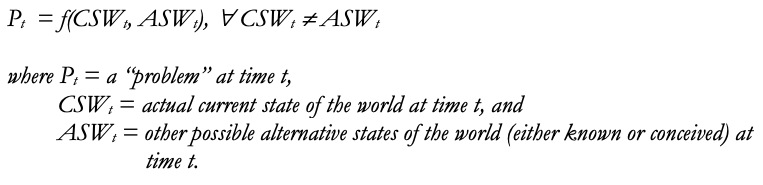
Every “problem” exists only because there is at least one, and possibly many, potential alternative states of the world – a “problem” derives its existence from the perceived or real difference between the actual state of the world and an alternative state of the world. Therefore, a problem exists only if there is some form of actual, perceived, or expected “gap”, i.e., a difference, between the current state of the world and other possible states of the world. Stated more precisely a “problem” is, therefore, a function of the actual current state of the world and some other possible alternative state(s) – whether real or imagined – of the world:
That problems are consciously created is neither understood nor appreciated as evidenced by the disproportionate amount of time and resources spent trying to solve problems relative to first trying to understand the nature of the problem itself.
The curious task of economics is to demonstrate to men how little they really know about what they imagine they can design. To the naive mind that can conceive of order only as the product of deliberate arrangement, it may seem absurd that in complex conditions order, and adaptation to the unknown, can be achieved more effectively by decentralizing decisions and that a division of authority will actually extend the possibility of overall order. Yet that decentralization actually leads to more information being taken into account.
F. A. Hayek
Retail electricity markets as an example of the complexity of choice
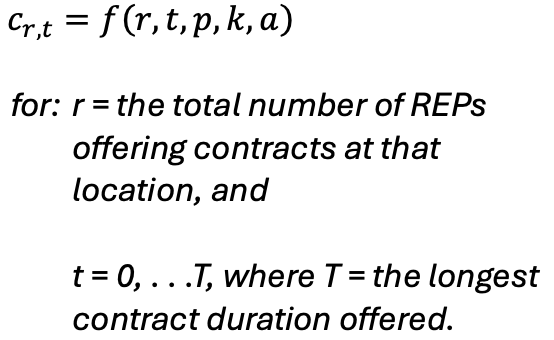
In de-regulated electricity markets, consumers purchase their electricity through bi-lateral contracts with a Retail Electricity Provider (REP). The consumer’s problem is to choose the optimal “path” of contracts so as to minimize the overall cost of electricity of a specific time horizon given the individual contracts they are offered and their monthly expected consumption. Each contract is defined by (1) the REP, “r”, who offered the contract, (2) the time, “t”, at which it is offered, (3) the contract price, “p”, of electricity, (4) the duration, “k”, of the contract, and (5) other factors, “a”, such as cancellation charges, block rates, etc. Thus, any electricity contract is a function of those five variables and it is the task of the consumer to chose the “best” option.
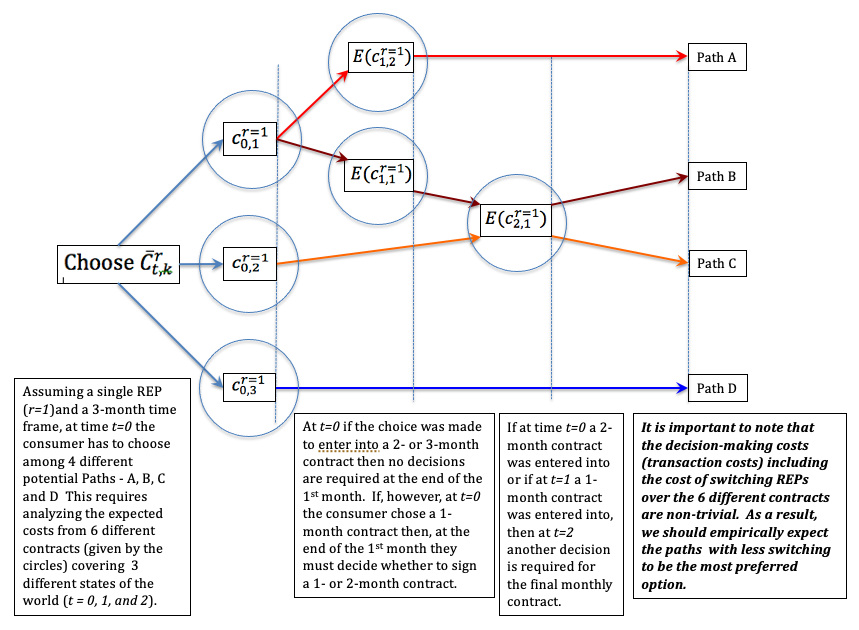
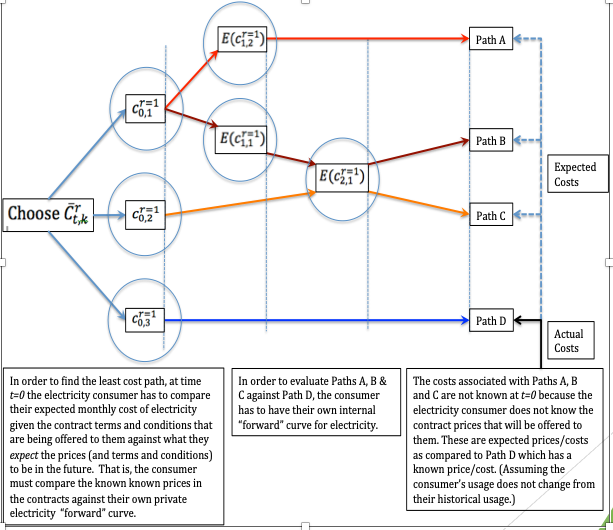
This is a discrete time dynamic optimization problem with varying initial and terminal positions. The diagram shows that at t = 0, the consumer has three immediate choices, a 1-month contract, a 2-month contract, and a 3-month contract. In order to compare all three options (paths), the consumer must form an expectation about what contracts prices will be in the next two periods so that they can compare those costs with the cost of entering into a 3-month contract. To the extent that consumers are offered contracts with a duration of more than 3 months the difficulty of the choice increases exponentially, The number of decisions that a consumer must make to choose the optimal electricity contact path is:
Where m is the duration of the longest contract. So, to choose the optimal contract path when there are 60 month contracts available, the consumer must make approximately 5.8quadrillion decisions. (Assuming contracting can occur for any length between 1 and 60 months.)
Making decisions is a costly endeavor and the REPs will benefit to the extent that they can increase those costs through differentiated and/or non-comparable contract durations (k), terms and conditions (a), product definitions, etc. – behavior that rarely benefits the consumer and is on display in most, if not all, retail electricity markets.